

What’s Inside an IV Drip? Ingredients Explained
If you’ve ever watched an IV bag drip and wondered what’s actually inside it, you’re not alone. Curiosity about what’s inside an IV drip is common, especially as IV hydration and nutrient infusions become more visible in wellness settings. The short answer is that most drips start with a sterile fluid base, and then (when appropriate) a provider may add electrolytes and specific nutrients based on goals, screening, and safety considerations.
This guide explains the most common IV drip components in plain language: what each ingredient is, what it does in the body, why it’s included, and what to consider before choosing a formulation. You’ll also learn why “more ingredients” isn’t automatically better, and why medical oversight matters with anything delivered through a vein.
If you’re exploring options for supervised hydration support, you can review our IV hydration and injections page.
How IV drips deliver fluids and nutrients
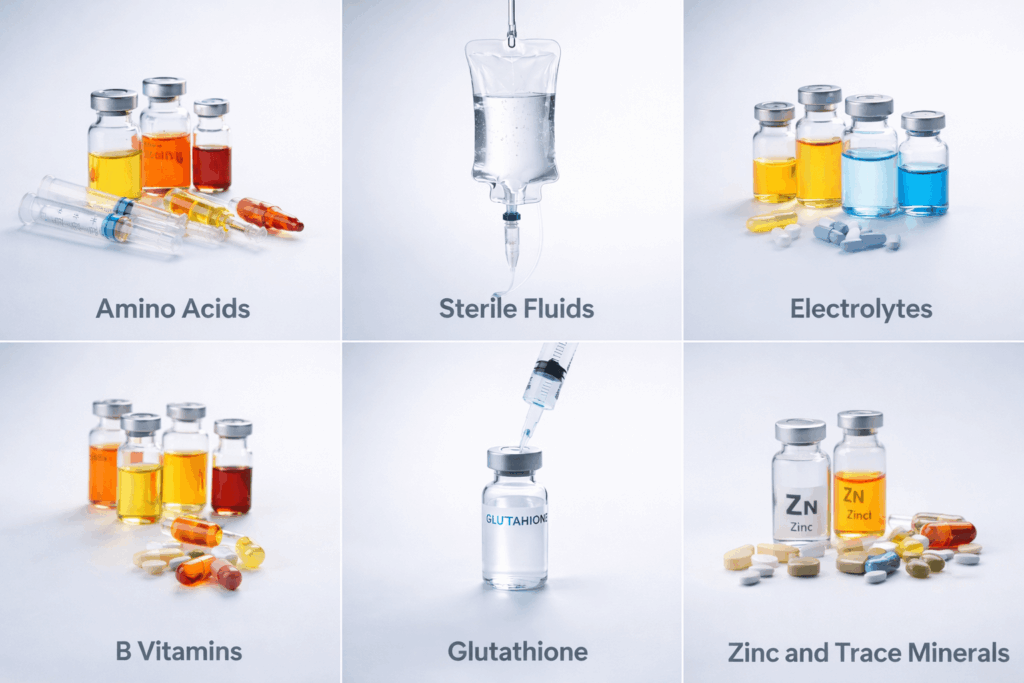
An IV drip delivers fluids and, when appropriate, nutrients directly into a vein. This allows ingredients to enter the bloodstream without passing through the digestive system.
Unlike oral supplements, which must be broken down and absorbed through the gut, IV therapy bypasses digestion. That means nutrients are delivered directly into circulation during the infusion.
However, the effectiveness of an IV drip depends on:
The ingredients used
The dosage
Your individual health status
Whether the treatment is medically appropriate
Understanding what’s inside an IV drip helps you evaluate whether it aligns with your goals.
Sterile Fluid
Most IV drips begin with a sterile crystalloid solution. Think of this as the “carrier” fluid that supports hydration and allows added ingredients to be delivered in a controlled way.
Normal saline (0.9% sodium chloride)
Normal saline is a sterile mixture of water and sodium chloride at a concentration designed to be compatible with the body’s fluid balance. It’s widely used in clinical care as a hydration and fluid-support solution. (Cleveland Clinic, 2024)
Why it may be used:
Supports hydration and fluid volume
Provides sodium and chloride, key electrolytes
Commonly used as a compatible base for IV administration
Lactated Ringer’s solution
Lactated Ringer’s is another sterile crystalloid solution sometimes used for fluid support. It contains sodium, chloride, potassium, calcium, and lactate (as sodium lactate). (Singh, 2023)
Why it may be used:
Designed as a “balanced” fluid with multiple electrolytes
Often used in clinical settings for fluid resuscitation and volume support
A key point: your base fluid is not just “filler.” It’s a meaningful part of the drip especially when hydration is the goal.
Electrolytes: Supporting Fluid Balance
Electrolytes are charged minerals involved in hydration, muscle contraction, and nerve signaling. In IV drips, electrolytes are typically used to support fluid balance and physiologic function, especially after fluid loss or during higher hydration demand.
Sodium and chloride
These are present in normal saline and also in balanced fluids like Lactated Ringer’s. Sodium helps regulate fluid balance and supports nerve function, while chloride contributes to maintaining normal acid-base balance.
Potassium
Potassium supports normal muscle function and is essential for normal electrical activity in the heart. Because potassium levels can be clinically sensitive, it’s not an ingredient to “add casually.” Its inclusion should always reflect screening and appropriate dosing.
Magnesium
Magnesium is involved in hundreds of enzyme systems and supports muscle and nerve function, energy production, and more. (National Institutes of Health Office of Dietary Supplements, 2026a.)
Why it may be included:
Muscle function support
Nerve function support
Support for normal energy metabolism pathways
Calcium (in some balanced fluids)
Calcium plays a role in muscle contraction and nerve signaling. It’s included in Lactated Ringer’s and may be considered in specific contexts. (Singh, 2023.)
Vitamin C: Antioxidant Support
Vitamin C is one of the most common ingredients added to IV drips.
It helps:
Support immune function
Promote collagen production
Act as an antioxidant
Because IV delivery bypasses digestive limitations, higher doses can be administered under supervision compared to typical oral intake. However, high doses should always be monitored appropriately.
B Vitamins: Energy and Metabolism
B vitamins are frequently included in wellness drips because they’re involved in energy metabolism, nervous system function, and red blood cell formation. A common ingredient discussed is vitamin B12.
Vitamin B12
Vitamin B12 supports healthy red blood cell formation, DNA synthesis, and the development and function of the nervous system. (National Institutes of Health Office of Dietary Supplements, 2025b.)
Why it may be included:
Support for normal neurologic function
Support for red blood cell formation
Used when a provider identifies low intake, absorption concerns, or risk factors
B12 is a good example of why “delivery method” matters less than “do you need it?” If someone has normal B12 status, adding B12 may not change outcomes. If someone is deficient, correcting the deficiency can be meaningful usually guided by labs and clinician oversight.
Glutathione: Cellular Antioxidant
Glutathione is a naturally occurring antioxidant produced in the body. In IV therapy, it is sometimes added separately or administered at the end of an infusion.
It plays a role in:
Neutralizing free radicals
Supporting detoxification pathways
Maintaining cellular health
Research continues to explore its role in various health applications, but clinical supervision is important when using higher doses.
Zinc and Trace Minerals
Some IV drips may include trace minerals like zinc.
Zinc helps:
Support immune function
Aid wound healing
Maintain normal cell growth
Trace minerals are typically used in smaller doses but can contribute to overall nutrient balance.
Amino Acids: Building Blocks of Protein
Certain IV formulations may contain amino acids, which are the building blocks of protein.
Amino acids:
Support muscle repair
Aid tissue recovery
Contribute to neurotransmitter production
They are sometimes included in formulations designed for recovery support.
Differences Inside Every IV Drips
A common misconception is that IV drips are standardized “recipes.” In reality, formulation can vary based on:
Goal (hydration support vs nutrient support)
Screening and medical history
Tolerance and prior response
Provider protocols and clinical judgment
If you’re comparing options, it helps to ask:
What is the base fluid?
Which electrolytes are included, and why?
Which vitamins/minerals are included, and why?
Is there a reason to suspect deficiency or higher need?
What are the potential side effects for this formulation?
Quality and Safety of IV Drips
An ingredient list is helpful, but it does not tell the whole story. When it comes to IV therapy, safety depends more on proper medical oversight, sterile technique, and appropriate screening than on the number of vitamins in the bag. Understanding how the therapy is delivered is just as important as knowing what’s inside it.
Any IV access introduces some level of infection risk if sterility is not properly maintained. Because a needle enters a vein, careful technique and trained administration are essential. Reputable medical sources consistently emphasize infection prevention and the importance of clinical supervision with intravenous access procedures (Mayo Clinic Press, 2024). This is why IV therapy should only be performed in a controlled setting with qualified professionals.
Appropriate screening also plays a critical role in safety. Individuals with certain medical conditions, such as kidney disease, heart failure, or electrolyte imbalances, may require additional caution when receiving fluids or nutrients intravenously. A thorough intake process, medication review, and clinical evaluation help determine whether a specific formulation is appropriate.
It’s also important to understand how IV nutrients compare to oral supplements from a regulatory standpoint. In the United States, dietary supplements are regulated differently than prescription medications, and they do not undergo the same premarket approval process (U.S. Food & Drug Administration, 2024). This distinction does not mean supplements are ineffective or unsafe, but it does highlight why quality, sourcing, and professional guidance matter.
Frequently Asked Questions
1. What is typically inside an IV drip?
Most IV drips start with a sterile fluid base such as normal saline or Lactated Ringer’s. Depending on the purpose, a provider may add electrolytes, vitamins like B12 or vitamin C, magnesium, zinc, or antioxidants such as glutathione.
2. Are IV drip ingredients the same for everyone?
No. Formulations can vary based on your hydration status, medical history, goals, and provider assessment. A proper screening process helps determine which ingredients, if any, are appropriate for you.
3. Is IV therapy more effective than taking vitamins by mouth?
IV therapy delivers nutrients directly into the bloodstream, while oral supplements must be digested first. Whether one works better depends on your goals, absorption ability, and whether you have a confirmed deficiency.
4. Are the vitamins in an IV drip safe?
When administered by trained professionals using sterile technique and appropriate dosing, IV ingredients are generally well tolerated. However, IV therapy may not be suitable for individuals with certain medical conditions, so evaluation is important.
5. Where can I find IV drips in Saraland, AL?
If you’re looking for professionally administered IV drips in Saraland, AL, you can review local clinic information, hours, and reviews through Google Business Profiles. This can help you confirm location details and learn more before scheduling an appointment.
The Verdict
Knowing what’s inside an IV drip makes it easier to separate facts from assumptions. Most IV drips begin with a sterile fluid base (like normal saline or Lactated Ringer’s), and may include electrolytes and select nutrients such as vitamin C, B vitamins, magnesium, zinc, or antioxidants like glutathione depending on the purpose and clinical screening.
The most important “ingredient” is not a vitamin. It’s the right formulation for the right person, delivered safely and with clear expectations. If you’re considering IV therapy, focus on why each ingredient is included, whether it matches your needs, and whether the process includes proper screening and sterile administration.